Crafting a thorough ‘understand and define’ report to better understand user problems, and web of related issues, which accelerated UX research efforts and onboarded new management to the team faster.
- interviews
- case studies
- gtm
- feedback
- analysis
- mapping

Situation
Partners (hotels and property owners who rent out their residence as a vacation rental) manage their listing on Booking.com in the admin area called the extranet.
All over the world vacation rentals are subject to various, national, state, and sometimes, city-level regulations in an effort to monitor and maintain the market. Partners are therefore required by their local laws to fill out a form in the extranet with the applicable information law makers ask of them. Internally, this was referred to as Short-term Rental licences (STR).
I joined the team that owned this experience.
We knew a portion of partners found the experience confusing and overwhelming. At worst, some didn’t fill out the form. By not doing this, they risked their property, or business, being shut and removed from Booking.com, ultimately impacting Booking.com’s business too.
Task
At first, I was tasked with creating a UX vision that could solve the user problem. However, I had to understand why partners didn’t fill out the form. By better understanding why this was the case, root issues could be addressed and solved with tactical solutions, underpinning any subsequent vision.
Action
I had to get the big picture. All of it. AKA “the big why”. Where regulations come from, how they “arrive” at Booking.com, what processes are there in place, which teams own other aspects of the experience, plus a whole lot more. I decided to centralise everything I learned which became a comprehensive “UX Understanding” report.
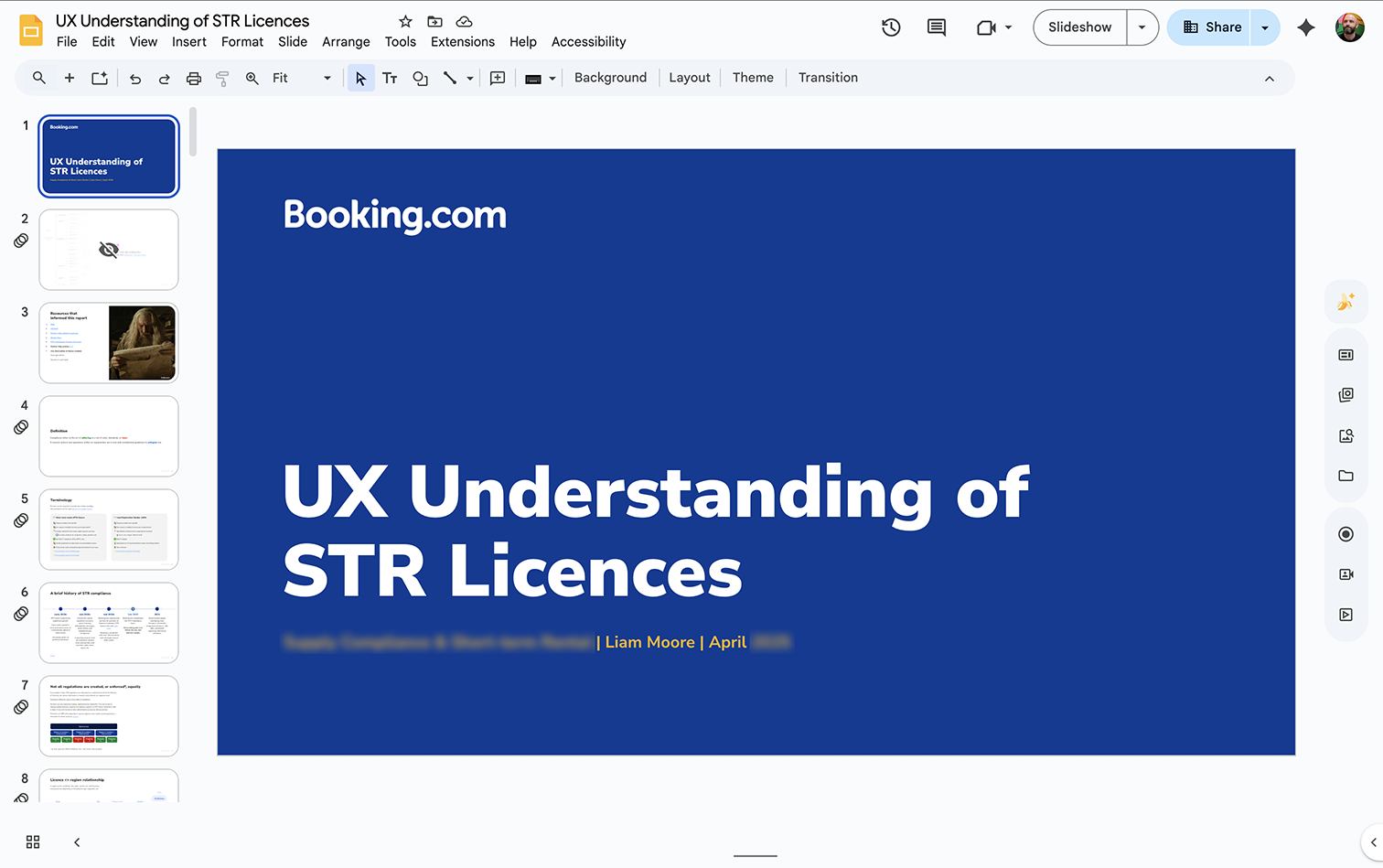
This would structure and organise my findings, which in turn would help a management changeover at the time and onboard new team members quickly and efficiently. Importantly, it would be a thorough “snapshot” of the present experience in order to base improvements off of.
By interviewing colleagues who process new regulatory requirements and create the forms for partners to fill out in the extranet, I was able to get close firsthand insight into their experience. The form creation tool had its own set of unique characteristics and I could see how their experience influences the end-user (partner) experience.

A simple ‘ease of use’ sepctrum illustrating how easy or hard creating a new regulatory form can be.
These interviews helped me map a typical brief-to-launch process and gauge how long the process takes. Depending on various factors, it can be anything from weeks to months.
But the end-user (partner) experience was where I spent most of my time. I needed to see:
- where in the extranet partners fill out these forms
- who exactly can do so (there are various user-account levels for partners and their staff)
- when in their user journey are they required to fill out the form
- how forms are validated, if at all, depending on the law
- what are the consequences of not doing so and how is this, amongst a lot of other information, communicated.
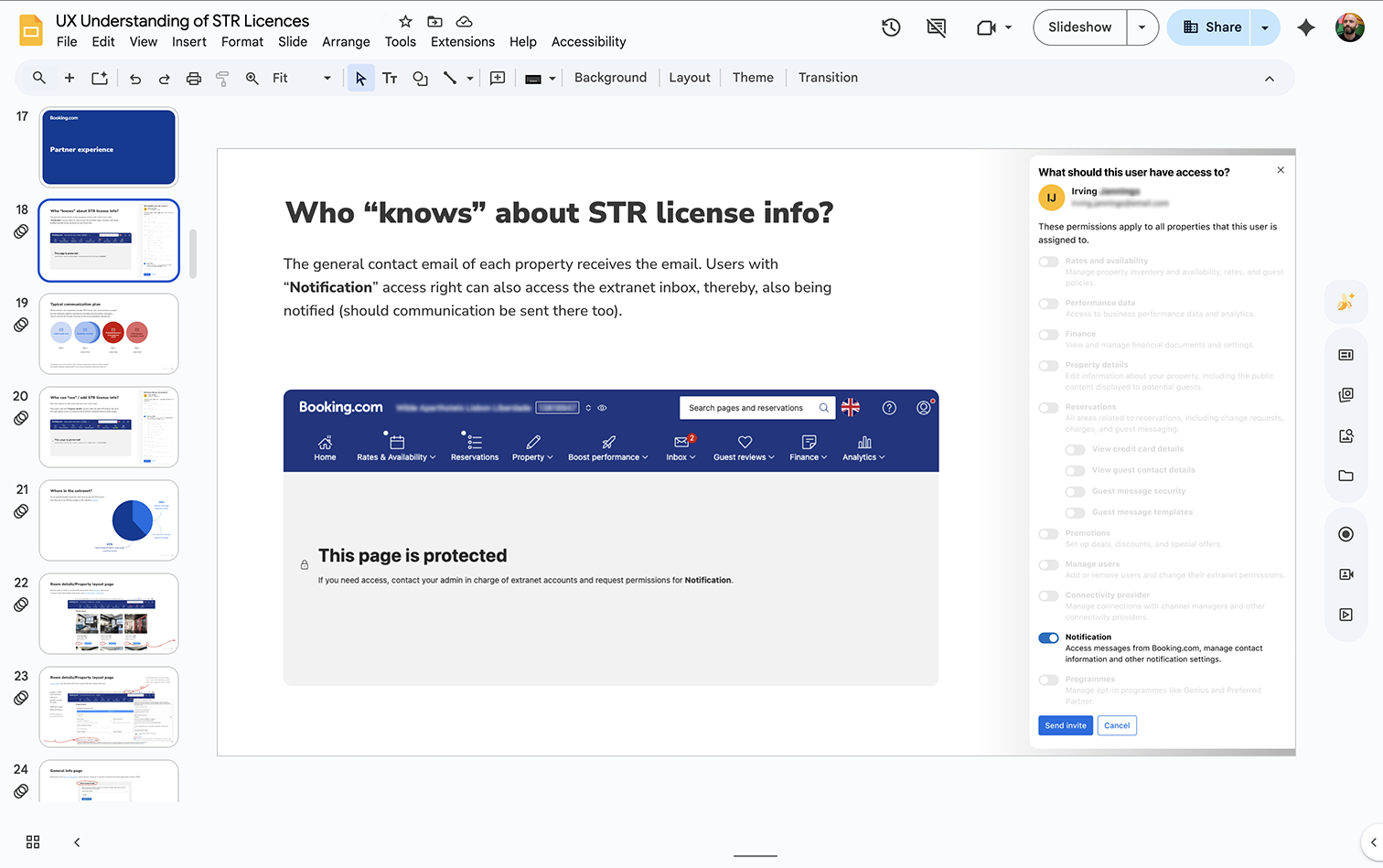
Showing exactly which user-account level partners have access to the page where the forms are filled out.
In order to not just know the above, I needed to see the impact. Together with my product manager, I was able to put together six country case studies. By analysing various markets—with a UX lens—I hoped to see which did better than others to inform “the big why”. I documented:
- communication plan, from initial email, reminders, and consequence emails, and timeframes
- communication engagement, the usual GTM (Go To Market) email stats; targeted, opened, clicked, satisfaction scores, etc.
- form completion rate, to see what percentage of partners completed the form, and when.
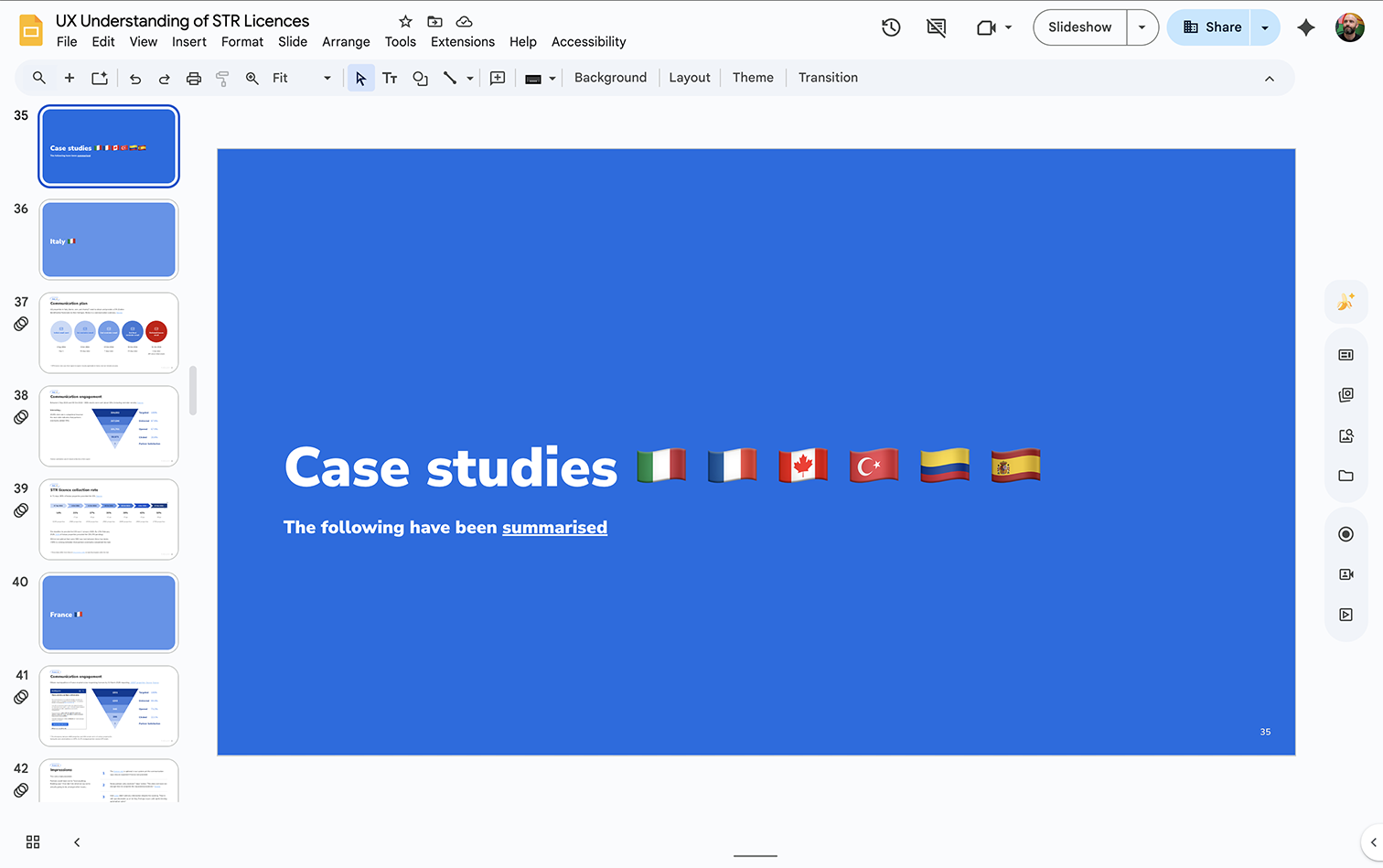
Looking around the world to understand which markets perform better than others.

Visualising the communication plan.
I was able to make impressions of each country’s experience and clearly saw a “sphere of influence”. For instance, if a partner has to apply for a licence from their local municipality, that process is outside of our influence. The partner would have to log back into their extranet and provide those necessary licence data. All we can do is communicate, at best, what they need to do.
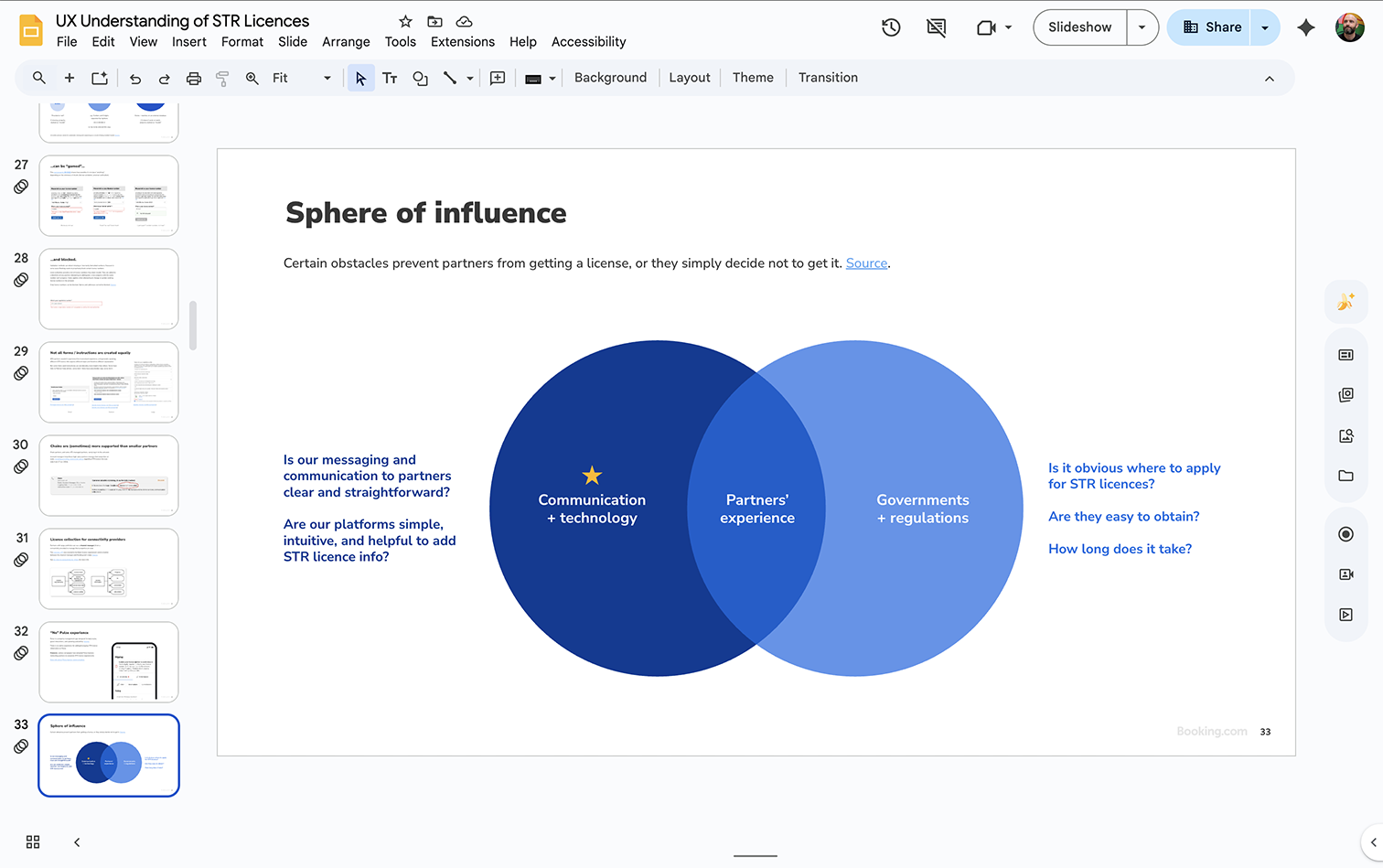
Venn diagram showing how some aspects of this line of work were in our direct influence and others weren’t.
Besides all of the above, I also reviewed anecdotal feedback on a partner forum board, chatbot questions they ask in the help centre website, and in-product feedback tools.

Questions and comments in a publically-facing forum board from partners expressing confusion.
It took several months to end up with the completed report. However, I still felt like I couldn’t see the big picture. I’m a visual thinker, and a Google Slide deck 80 or so slides big, can be a lot to process—no matter the executive summaries or TL;DRs.
Result
Bird’s eye view
Zooming out to see connected problems and their relationships to each other.
Accelerated colleague’s learning
Deep learning that benefited other’s involvement and onboarding.
Tactical followup
UX research team was better equipped to conduct follow up analysis.
I’m a big fan of Adam Amran’s Untools website. His tools, and bi-weekly emails, are extremely practical and great at helping designers think. I can’t recommend him enough.

This issue/problem tree showed how certain problems had a source, how that source had a source, how they might be related, and ulimately how it all related to a big user and business problem.


I was inspired to visualise my report as an issue tree and map the problems. I even made my own spin on it and linked related issues from different branches demonstrating how problems don’t exist in a vacuum:
- partner doesn’t understand why they’re being asked
- instructions are difficult to understand
- partner is new to renting out their property
- no link to law / source
- partner doesn’t know where to apply for licence information
- partner can’t find the form
- partner can’t add licence information on the form
- information provided isn’t validated
- this is “desirable” = correct validation method in place
- partner didn’t receive a licence
- local municipality has a limited quota of licences
- amongst others
These were subtle, yet distinct problems. Laying this out saved my UX researcher months of his time. He was able to set up an intercept survey, with the right questions, to the right segment, at the right time in order to size how big or small a problem was. We were strategic with our understanding and sizing for the product team’s benefit.
New management onboarded faster and were able to get a deep understanding of the present user experience.
What I learned
Whilst my involvement in this project would’ve continued, I realised big impact isn’t just design artefacts in Figma or moving great big metrics, it’s also in the thorough understanding of an experience, problem, or journey.
When root issues can be identified, then sized, tactical improvements can be explored and prioritised.
What colleagues said
“Liam’s extensive pre-work made it incredibly easy to create a concise and well-structured shortlist of reasons for the survey. I also really appreciate Liam’s engagement with the research process. Instead of waiting for findings to be shared at the end, he’s actively involved from the very beginning. Making it a truly collaborative process which not only makes work a lot more fun but also enhancing the quality of the work.”
– Senior UX Researcher
“Liam’s proactivity resulted in a complete walkthrough of the current UX, covering some very edge cases that even we weren’t aware of. His work helped us uncover improvement possibilities and new metric tracking opportunities.”
– Product Manager
“It was like listening to a TED talk or podcast or one of those shows on TV and suddenly it’s an hour later and you’re deeply invested in how a factory runs.”
– Lead UX Writer
“PS I just read your UX understanding for STR licenses last week 🤯”
– Senior UX Writer